Abstract
Science organizes the recognizable targets of objects and phenomena in the testable form, and it functions to understand, define, quantify, visualize or simulate properties of the target in the syllogistic-hierarchy of framing, modeling, and explanation with sound inferences of language. Human Self maintaining the homeostasis is defined in the thinking-frame. The physical Self is the substantial model-system defined in the physical frame, and the mental Self is the recognition-behavioral model-system defined in the psychological frame. The recognition-behavioral model-system that was analyzed via the scientific procedure, was considered to perform language-metabolism with the thinking-codes of homology-/simplification, clustering, operation and modeling, which are mounted in the Modeling-layer of Neuronal Network of the brain, with economic and stubborn manner coming from the biological characteristics. Systems theory is the transdisciplinary study of systems complex-networked interrelated and interdependent components. Human Self is the meta-model-system complex-networked the functional single-model-systems. The mental Self that was re-defined corresponding to the physical/psychological model-system coming from Chinese philosophy and Chinese traditional medicine, developed to the neuro-psychological Self under the idea of Systems theory. Neuro-psycho-pharmacological effect of the anti-epileptic agents Carbamazepine, Lamotrigine and Valproate on Exceed Stimulation-amplify of patients suffering from Bipolar-disease, which was not clear until recently, was compatibly explained via the neuro-psychological Self. Finally, the emergent neuro-psycho-pharmacological explanation was considered to be induced by symbolically-figuring the neuro-psychological Self in the neuro-psychological frame.
2. Structure of Recognition-Behavioral Model-System of Human Self
2.1. The Framing
Human Self is a model-system to maintain the homeostasis. The physical Self defined in the physical frame is substantial model-system maintaining the physical homeostasis via the substance-metabolism, and the mental Self defined in the psychological frame is recognition-behavioral model-system maintaining the recognition-behavioral homeostasis via the language-metabolism. Naturally, both of the model-systems function under the biological characteristics of the human being. In the section, the recognition-behavioral model-system is further analyzed in the frames of biology, cognitive linguistics, computer-neuroscience and logics.
2.2. The Modeling
2.2.1. Substantial Model-System of the Physical SELF
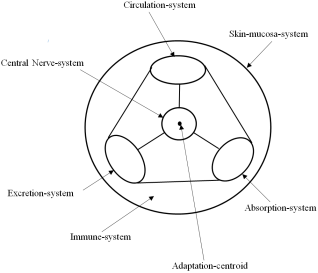
The physical Self maintains the physical homeostasis. The physical Self is organized as topological complex-network of physical Circulation-system, physical Adsorption-system, physical Excretion-system and physical Central Nerve-system, and is protected with physical Immune-system filling the space and physical Skin-mucosa-system covering it. Central Nerve-system places in the center of the complex-network to integrate functional activities of the physical systems via the neuron-fibers, and the centroid is distinguished to Adaptation-centroid. The physical Self is symbolically schemed in (
Figure 1). Functional activities of the system-modules are maintained via the substantial model-system mounted in bio-membrane of cells configuring the system-modules. Foreign macro-molecules/proteins are digested to micro-molecules/amino acids by the catabolic enzymes of Absorption-module, and the micro-molecules are sent to the system-modules via Circulation-system. Cells configuring the system-modules intake the necessary micro-molecules via the transporters of the bio-membrane, and synthesize inner macro-molecules via the metabolic enzymes mounted in the bio-membrane. Both of the transporters and the enzymes are expressed corresponding to the codes mounted in the genome, and validity of the synthesized inner macro-molecule has been empirically decided via enormous try and error of animals to maintain the physical adaptation. Namely, the physical Self maintains the physical homeostasis via the step-by-step substance-metabolism of the substantial model-system which involves the genomic codes expressed in the bio-membrane. Nevertheless, some foreign micro-molecules of drugs and toxins directly affect the substantial model-system.
Figure 1. The physical Self.
The physical Self is topologically organized to complex-network of Circulation-system, Adsorption-system, Excretion-system and Central Nerve-system, and it is protected with the including Immune-system and the covering Skin Mucosa-system. Central Nerve-system places in the center of the complex-network to integrate functional activities of the physical system-modules via the neuron-fibers, and the centroid is distinguished to Adaptation-centroid. The activities are maintained via the substantial model-system mounted in bio-membrane of cells configuring the system-modules.
2.2.2. Recognition-Behavioral Model-System of the Mental SELF
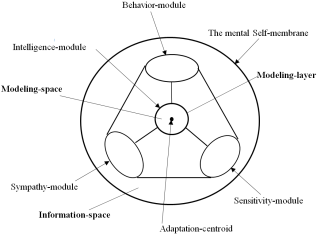
The mental Self that maintains the recognition-behavioral homeostasis is organized in Central Nerve-system. The mental Self is complex-network of neurological Behavior-module, neurological Sympathy-module, neurological Sensitivity-module and neurological Intelligence-module, whose functional activities are epigenetically determined. The complex-network is protected by the mental Self-membrane, and Intelligence-module places in the center of the complex-network because of the integration-role. The centroid is distinguished to Adaptation-centroid. Modeling layer covering Intelligence-module separates the mental Self to the inner Modeling-space and the outer Information-space, and the recognition-behavioral modeling-system is mounted in the Modeling layer. The mental Self is symbolically schemed in (
Figure 2). The mental Self produces verbal single-models and conceptual meta-models to maintain the recognition-behavioral homeostasis. Animals operatively abstract necessary circumstantial information, and integrate the information to meaningful signal via the first signal-system of Conditioning-reflection. The mental Self also works as the second signal-system to develop the necessary signals to symbolical single-models of terms and formulas corresponding to the single-model-codes. The mental Self, furthermore, hyper-orders the necessary single-models to a meaningful meta-model of concept corresponding to the meta-model-codes. Compatibility of the formula has been explained with the logical manner of Mathematics, and reproducibility of the concept has been maintained with the empirical manner of Natural language. Namely, the mental Self maintains the recognition-behavioral adaptation via the step-by-step language-metabolism according to the model-codes mounted in the Modeling-layer.
Figure 2. The mental Self.
The mental Self is organized as complex-network of Behavior-module, Sympathy-module, Sensitivity-module and Intelligence-module, and it is protected by the mental Self-membrane. Intelligence-module places in the center of the complex-network because of the integration-role via the neuron-fibers, and the centroid is distinguished to Adaptation-centroid. Modeling layer covering Intelligence-module separates the mental Self to the inner Modeling space and the outer Information-space.
2.2.3. Performance of the Recognition-Behavioral Model-System
Human-thinking is followed by language-inferences of qualitative-reasoning induction and quantitative-reasoning deduction. The recognition-behavioral modeling-system is also followed by the language-inferences. Analogy is an inductive inference of homology/simplification to treat analogues of qualitative-connotation. Algorism is a deductive inference of operation to treat digitals of quantitative-connotation. Pattern-recognition is an inductive/deductive inference of clustering to perform exchange of analogues and digitals. Artificial Intelligence (AI) was originally constructed to investigate information-processing in Neuronal Network of the human brain. AI is defined to a vertical algorism-unit which consists of artificial neurons, artificial synapses and artificial weights for information-stream, and the components function similarly to those of Neuronal Network. AI of Deep Neural Network (DNN) that
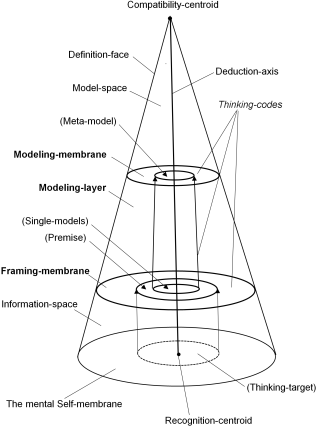
has multiple layers between the input and output layers, can be trained the algorism via multiple times of vertical information-transverse between the input and output layers. AI of Recurrent Neural Networks (RNNs) in which data can flow in horizontal direction, could be used for language-modeling followed by Machine Reading Catalog (MRC) which performs clustering like as pattern-recognition. AI of Generative Pre-trained Transformer (GPT) could work as a language-generator followed by Corpus which provides catalogue of word-connections like as sentence-models. Namely, the recognition-behavioral model-system involves the thinking-codes of homology/simplification, clustering, operation and modeling as the specific informal-logical structures in the Modeling layer of Neuronal Network. Scientific procedure originally has the logical structure of valid premise, sound inference and compatible explanation, and nature of language is set-classification and map-specification. So, the recognition-behavioral model-system is constructed as syllogistic-hierarchy of framing for valid premise, modeling by sound inference, and explaining with consistency, and the hierarchy is arranged with the set-classification and the map-specification. Adaptation-centroid of the recognition-behavioral model-system is connected to Recognition-centroid, and the connect-line is distinguished to Deduction-axis building-in deduction. The system is covered with Definition-face, and differs to 3layers-hierarchy. The lower layer is Information-space to restore meaningful signals by forming association-network. The middle layer is Modeling layer that consists of Framing-membrane, Modeling membrane and the vertical neuronal network between the membranes. Framing membrane and Modeling membrane mount the thinking-codes of homology/simplification, clustering and modeling
, and the vertical neuronal network mounts the thinking-code of operation. The upper layer is Model-space to keep previously-produced models. Now, meaningful signals of Thinking-target are operatively abstracted via the frame, and are set as constituents of Premise in Framing membrane. The constituents are organized to single-model of term/formula via the homology/simplification-code and the single-model-code of Premise. Analogues of the single-models are exchanged to digitals via the clustering-code, and the digitals are customized via
the operation-code. The customized digitals are mapped to Modeling membrane, and re-exchanged to analogues via the clustering-code. The analogues are hyper-ordered to meta-model of concept via the meta-model-code that complex-networks the relevant single-models. Thus, a new meta-model of concept is produced in Modeling space. The recognition-behavioral model-system is symbolically represented in (
Figure 3)
. Figure 3. Human recognition-behavioral model-system.
Human recognition-behavioral model-system is constructed in Neuronal Network of the mental Self. The system is covered with Definition-face, has Deduction-axis to check logical compatibility, and differs to 3layers-hierarchy. The lower layer is Information-space to restore meaningful signals by forming association-network. The middle one is Modeling layer that consists of Framing membrane and Modeling membrane mounting Thinking-codes of analogy, pattern-recognition and modeling, and the vertical neuronal network between the membranes mounts Thinking-code of algorism. The upper one is Model-space to keep the previously-produced models. Meaningful signals of (Thinking-target) are operatively abstracted via Framing membrane, and are set as constituents of (Premise). The constituents are organized to (Single-models) via Thinking-codes of analogy and single-model. Analogues of (Single-models) are exchanged to digitals via Thinking-codes of pattern-recognition, and the digitals are operated via Thinking-code of algorism. The operated digitals are mapped to Modeling membrane, and re-exchanged to analogues via Thinking-code of pattern-recognition. The analogues are hyper-ordered to (Meta-model) via Thinking-code of meta-model. Thus, a new (Meta-model) is produced in Modeling space.
2.3. The Reality
Meaningful signals of the thinking-target are operatively collected corresponding to single-model-codes mounted in the frame which was empirically formed via the learning and experiences. However, all of the meaningful signals are not integrated to the single-models, and all of the single-models are not hyper-ordered to the meta-model. In fact, Meme is social/cultural signal like as Gestalt, and Brief that instantly activates human recognition is a single-model induced via the second signal-system of Conditioning-reflection. Intelligence-module that is finding new single-models by emphasizing the analogy and the pattern-recognition, does not overwrites-save all of the new-successful single-models. For example, term of Occam’s razor indicates an algorism-procedure to select a valid hypothesis from feasible hypotheses. As algorism-ability of the mental Self is more restricted than that of AI, the mental Self performs the algorism-procedure not with an exhaust search-manner but with an empirical guesswork-manner. Human persists on a previously-successful thinking-frame, and easily accepts Pre-established Harmony of the previously-successful single-model. Namely, human recognition-behavioral model-system economically and stubbornly performs the language-metabolism. The economical and stubborn thinking-manner produces Selection Bias and Cognitive Dissonance. Selection Bias might result in Pseud Science that insistently explains realities of the verbalized World with ad-hoc hypotheses, and Cognitive Dissonance might result in Fanaticism that insistently explains the realities with supernatural surmises. The economical and stubborn manner naturally comes from the biological characteristics of the mental Self maintaining the recognition-behavioral homeostasis.
3. Significance of Symbolically-Figured Human Self
3.1. The Framing
Neuro-pharmacological researches have analyzed single-model of transmitter-receptor in the neuro-pharmacological frame. Nevertheless, neuro-psycho-pharmacological effect of anti-epileptic agents of Carbamazepine, Lamotrigine and Valproate on a neuro-psychiatric disorder Bipolar-disorder was not clarified via the conventional neuro-pharmacological researches. Systems theory is the transdisciplinary study of systems complex-networked interrelated and interdependent components, and human Self is the meta-model-system complex-networked the functional single-model-systems. Chinese philosophy indicated the simple single-model-system, and Chinese traditional medicine represented the holistic meta-model to explain human physical adaptation. In this section, the mental Self develops to the neuro-psychological Self corresponding to the physical/psychological model-system coming from Chinese philosophy and Chinese traditional medicine under the idea of Systems theory, and neuro-psycho-pharmacological effect of the anti-epileptic agents on a symptom of Bipolar-disorder is analyzed with the neuro-psychological Self.
3.2. The Modeling
3.2.1. Physical/psychological Model-System Coming from Chinese Philosophy and Chinese Traditional Medicine
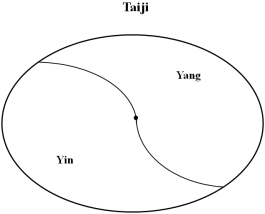
Figure 4. Chinese philosophical single-model Yin-yang and Taiji.
Yin-yang is Chinese philosophical concept describing the opposite but interconnected forces. Taiji integrating Yin-yang is holistic single-model of the physical Self in Chinese philosophy.
Figure 5. The physical meta-model of Chinese traditional medicine.
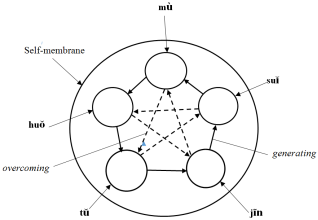
Holistic Taiji symbolically develops to functional modules of Zangfu (five organ) corresponding to mù (wood), huŏ (fire), tŭ (earth), jĩn (metal) and shuĭ (water) of Wuxin (five agents) of Chinese philosophy. The organ-modules are complex-networked, and are generating and overcoming each other. Activity of the organ-module is maintained with qi (life-energy), xiĕ (blood) and jīnyѐ (body-fluids). Crude drags are corresponding to the organ-modules, and they selectively cultivate qi, xiĕ, and/or jīnyѐ of the corresponding organ-modules. Physical condition depends on the activities of the organ-modules, and the malfunctions result in physical dis-adaptation. Recipe of Chinese traditional medicine is composed with the crude drags, and the recipes are treated to holistically-correct mal-combinations of the organ-module-activities.
Yin-yang is concept describing the opposite but interconnected forces in Chinese philosophy, and Taiji integrating Yin-yang is a single-model of the physical Self in Chinese philosophy (
Figure 4). Holistic Taiji develops to functional modules of Zangfu (five organ) corresponding to mù (wood), huŏ (fire), tŭ (earth), jĩn (metal) and shuĭ (water) of Wuxin (five agents) of Chinese philosophy. The organ-modules are complex-networked, and are generating and overcoming
each other. Activity of the functional organ-module is maintained with qi (life-energy), xiĕ (blood) and jīnyѐ (body-fluids), and the crude drugs selectively cultivate the qi, xiĕ, and/or jīnyѐ of the organ-modules. This is the meta-model of the physical Self in Chinese traditional medicine. Physical condition depends on the activities of the organ-modules, and the malfunctions result in physical dis-adaptation (
Figure 5). Crude drags are corresponding to the organ-modules, and they selectively cultivate qi, xiĕ, and/or jīnyѐ of the organ-modules. Chinese traditional medicine recipes are composed with the crude drags, and the recipes are treated to holistically-correct mal-combinations of the organ-module-activities.
3.2.2. Neuro-psychological Self
Neuroscientific studies reported that mammalian brain works via complex-network of the adrenergic, serotonergic, cholinergic and dopaminergic neuronal modules
| [3] | Bullmore E, Sporn O. (2012). The economy of brain network organization. Nature Reviews Neuroscience, 13, 336-349. https://doi.org/10.1038/nrn3214 |
| [7] | Perona MTG, Waters S, Hall FS, Sora I, Lesch KP, Murphy DL, Caron M, Uhl GR. (2008). Animal model of depression in dopamine, serotonin, and norepinephrine transporter knockout mice: prominent effects of dopamine transporter deletions. Behavioral Pharmacology 19, 566-574. https://doi.org/10.1097/FBP.0b013e32830cd80f |
| [8] | Salnyeri Z, Kovacs GL. (1994). Role of oxytocin in neuroadapation to drugs of abuse. Psychoneuroendocrinology 19, 85-117. |
[3, 7, 8]
. The neurological Self is constructed as a complex-network of the cholinergic neuronal module (C) preserving stress-coping memories, the adrenergic neuronal module (A) inducing stress-coping behaviors, the serotonergic neuronal module (S) keeping physical strength and the dopaminergic neuronal module (D) integrating these module-functions. A-C-D circuit induces learning behaviors and/or conditioning, C-S-D circuit induces emotional behaviors, and S-A-D circuit induces instinctive behaviors
. Circuit of D-(C-A-S) induces voluntary learning to gain successful stress-coping. D recognizes the successful stress-coping via assessment of the dopaminergic neuronal activity. Previously, human humoral stress-coping glycolipids were reported to follow the module-activities
. Therefore, the module-functions are epigenetically determined, and the module-activity is represented as the module-size corresponding to the glycolipid-production. The neurological Self further develops to the neuro-psychological Self. C and A of the neurological meta-model are united to
Sensitivity-module, which is responsible for the stress-sensitivity. The A and S are united to Behavior-module, which is responsible for social behavior resulting in fight and flight. S and C are united to Sympathy-module,
which is responsible for the social allies-recognition. D integrating information sent from the modules, evolves to Intelligence-module that recognizes the integration-compatibility as dopaminergic pleasure. Symptoms of neuro-psychiatric diseases are corresponding to deformation of the module-shape.
3.2.3. Neuro-psychological Self of Patients Suffering from a Neuro-psychiatric Disease Bipolar-disease
Sensitivity-module that works to control input of stress-information, is responsible for Exceed Stimulation-amplify of a neuro-psychiatric disease Autism-Spectrum Disorder (ASD), and Sympathy-module that works to communicate the sympathy-allies, is responsible for Communication-disorder of ASD
| [9] | Tarver J, Vitoratou S, Mastoroianni M, Heaney N, Bennett E, Gibbons F, Fioli F, Absoud M, Ramasubramanian L, Simonoff E, Santosh P. (2020). Development and Psychometric Properties of a New Questionnaire to Assess Mental Health and Concerning Behaviors in Children and Young People with Autism Spectrum Disorder (ASD): The Assessment of Concerning Behavior (ACD) Scale. Journal of Autism and Developmental Disorders, 51(8), 2812-228. https://doi.org/10.1007/s10803-020-04748-1 |
[9]
. Behavior-module also works to control social fight or flight, and is responsible for Hyperactivity and Inattention of a neuro-psychiatric disease Attention-Deficit Hyper-Activity Disorder (ADHD)
| [5] | Keulers EHH, Hurks PPM. (2021). Psychometric properties of a new ADHD screening questionnaire: Parent report on the (potential) underlying explanation of inattention in their school-aged children. Child Neuropsychology, 27, 1117-1132. https://doi.org/10.1080/09297049.2021.1937975 |
[5]
. Intelligence-module is responsible for neuro-psychiatric diseases Intellectual Disabilities and Selective Learning Disability
| [10] | Van Rhijin J-R, Shi Y, Bormann M, Mossink B, Frega M, Re caioglu H, Hakobjan M, Gunnewiek TK, Schoenmaker C, Palmer E, Faibre L, Kittel-Schneider S, Schbert D, Brunner H, Franke B, Kasri NN. (2022). Brunner syndrome associated MAOA mutations result in NMDAR hyperfunction and increased network activity in human dopaminergic neurons. Neurobiological Disorders, 163, 105587. https://doi.org/j.nbd.2021.105587 |
[10]
. Patients suffering from Bipolar-disease firstly show the Exceed Stimulation-amplify coming from the Sensitivity-module. The Exceed Stimulation-amplify is not comfortable. The patients in the manic state stimulate the Behavior-module for doing fight or flight for deceasing the discomfort. Failure of the fight falls the patients in the depression state, and failure of the flight falls the patients in Abuse of substance, love affair, eating and/or self-injury which induces quick and temporary dopaminergic pleasure to the Intelligence-module. Furthermore, Bipolar-disease patients who are exposed the serious discomfort might try to commit Suicide to eliminate the unbearable discomfort. Anxiety unknown the origin also induces a severe discomfort, and the Intelligence-module exposed by the severe discomfort produces Hallucination and Delusion. Namely, Exceed Stimulation-amplify induces the other neuro-psychotic symptoms of Bipolar-disease, so, Bipolar-disease patients are considered to have a dysfunction in the Sensitivity-module of the neuro-psychological Self.
3.2.4. Neuro-psycho-pharmacological Action-locus of the Anti-epileptics on the Neuro-psychological Self of Patients Suffering from Bipolar-disease
Anti-epileptics of Carbamazepine, Lamotrigine and Valproate are used to treat Exceed Stimulation-amplify of the patients suffering from Bipolar-disease. The anti-epileptics are considered to induce the anti-epileptic effect mainly via the Na-channel blockade. The anti-epileptic agents do not significantly affect to the adrenergic, the serotonergic or the dopaminergic neuron, however, they were reported to protect the cholinergic neuron
| [1] | Belli H, Ural C, Akbudak M. (2012). Borderline personality disorder: bipolarity, mood stabilizers and atypical antipsychotics in treatment. Journal of clinical Medical Research, 4(5), 3001-3008. https://doi.org/10.4021/jocmr1042w |
| [2] | Bozzatello P, Garbarini C, Rocca P, Bellino S. (2021). Borderline Personality Disorder: Risk Factors and Early Detection. Diagnostics (Basel), 11(11), 2142. https://doi.org/10.3390/diagnostics11112142 |
| [4] | Eleuteri S, Monti B, Brignani S, Contestabile A. (2009). Chronic dietary administration of valproic acid protects neurons of the rat nucleus basalis magnocellularis from ibotenic acid neurotoxicity. Neurotoxin Research, 15(2), 127-132. https://doi.org/10.1007/s12640-9013-5 |
[1, 2, 4]
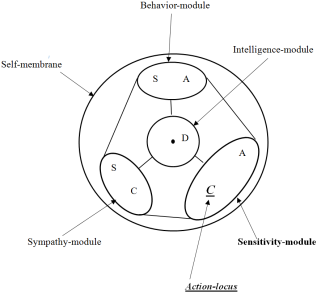
. Therefore, neuro-psycho-pharmacological action-locus of the anti-epileptics on Exceed Stimulation-amplify of Bipolar-disease is considered to the cholinergic neuronal module (C) of Sensitivity-module controlling the stress-sensitivity. Neuro-psychological Self of patients suffering from Bipolar-disease and the action-locus of the anti-epileptics are schematically represented in (
Figure 6). Lithium having Na-channel blocking activity is used not only to suppress exceed emotion-amplify but also to treat Exceed Stimulation-amplify. Lithium would also protect the cholinergic neuron via the Na-channel blocking activity like as the anti-epileptics.
Figure 6. Action-locus of the anti-epileptics on Bipolar-disease.
The neurological Self is constructed as complex-network of the cholinergic neuronal module (C) preserving stress-coping memories, the adrenergic neuronal module (A) inducing stress-coping behaviors, the serotonergic neuronal module (S) keeping physical strength and the dopaminergic neuronal module (D) integrating these module-functions. C and A of the neurological Self are united to Sensitivity-module of the neuro-psychological Self, which is responsible for the stress-sensitivity. The A and S are united to Behavior-module of the neuro-psychological Self, which is responsible for social behavior resulting in fight and flight. S and C are united to Sympathy-module of the neuro-psychological Self, which is responsible for the social allies-recognition. D of the neurological Self evolves to the Intelligence-module of the neuro-psychological Self corresponding to acquirement of the language-operation. The neuro-psychological Self is covered by Self-membrane, and activities of the modules are represented as the shapes. Patients suffering from Bipolar-disorder have Exceed Stimulation-amplify in the Sensitivity-module. Anti-epileptic agents of Carbamazepine, Lamotrigine and Valproate do not significantly affect to the adrenergic, the serotonergic and the dopaminergic neuron, but they protect the cholinergic neuron. Therefore, neuro-psycho-pharmacological Action-locus of the anti-epileptics, is considered to the cholinergic neuronal module (C) involved in the Sensitivity-module of patients suffering from Bipolar-disease.
3.3. The Reality
In the section, the neuro-psychological Self was figured as the neuro-psychological meta-model-system complex-networked the neuro-psychological single-model-system under the idea of Systems theory. Neuro-psycho-pharmacological action-locus of the anti-epileptics on Exceed Stimulation-amplify of patients suffering from Bipolar-disease, which was not clear until recently, was compatibly explained by symbolically-figuring the neuro-psychological Self. These suggest that emergence involved in Systems theory is induced by symbolically-figuring the model-system defined in the thinking-frame.





 Share This Article
 Twitter
 Linked In
 Facebook
 Copy
Copy Download